In brief
Multi-model councils are marketed as adversarial verification engines. Four frontier models cross-examine each other, surface blind spots, and produce a verdict no single model could manufacture alone. But the telemetry tells a different story. Across eight debates, the same pattern surfaced repeatedly: when models agreed, they were almost never independently verifying each other. They were echoing the same search snippet, converging from the same pretraining prior, or folding under the rhetorical weight of a previous turn. The Council caught itself doing it. Unanimity in a multi-model system is not evidence of truth. It is evidence of correlation.
Log #9 covered the model swap you never see. The badge says GPT-5.6 Terra. The telemetry says GPT-4o. The engine degraded gracefully. The UI lied.
This is the second lie, and it is deeper. It is not about what model ran. It is about what agreement means.
Across eight debates, four hundred thousand tokens, and multiple execution modes, the same pattern surfaced. When models converged on a claim, the convergence was almost never adversarial. It was almost never the result of one model persuading another with evidence. It was the result of all four models pulling from the same prior and reaching the same endpoint. The mechanism was not cross-examination. The mechanism was correlation.
The most honest moment in the entire experimental corpus came from the synthesis itself.
The Mechanics of Synthetic Corroboration
Extended mode, debate E4. No document. Tools enabled. Four models. Three rounds. Fifty-three percent confidence. Thirty-six cited sources.
The synthesis produced a finding that stopped me cold:
Two models repeated the same 10-40% accuracy drop figures from the same search snippet, which creates the appearance of corroboration without independent verification. That is itself an instance of the failure mode under discussion.
Read that again. The Council diagnosed its own echo chamber in real time. Two models. Same headline numbers. Same source snippet. Neither checked the original paper. Neither verified the URL. Both presented the figures as independently discovered evidence. They were not. They were echoing the same context-window fragment.
This is synthetic corroboration. The models did not independently reach the same conclusion from different angles. They encountered the same text in the same context window, absorbed its rhetorical weight, and repeated it. To a reader, two models citing the same statistic looks like confirmation. To the telemetry, it is one source, wearing two badges.
Shared Training, Shared Answers
The mechanism underneath synthetic corroboration is simpler and harder to fix.
Frontier models share pretraining corpora. Common Crawl, Wikipedia, GitHub, books, academic papers. The overlap is not marginal. It is structural. When all four models are asked to evaluate a claim about multi-model reliability, they are drawing from a near-identical pool of papers, benchmarks, and arguments. The Wang et al. self-consistency result. The Du et al. multi-agent debate paper. The Zheng et al. judge-bias findings. Every model knows them. Every model cites them.
The appearance of independent verification is manufactured by the fact that four models say the same thing. But they are not four independent observers. They are four instances of approximately the same knowledge distribution with different brand names.
Claude Sonnet 4.6 made the point directly in one debate, and it survives unrebutted across the entire corpus: the correct baseline for a multi-model council is not an average single-model response. It is the strongest single model with optimal prompting, extended reasoning, and tool access. That comparison is absent from every citation produced in every debate.
The Synthesis Caught Itself
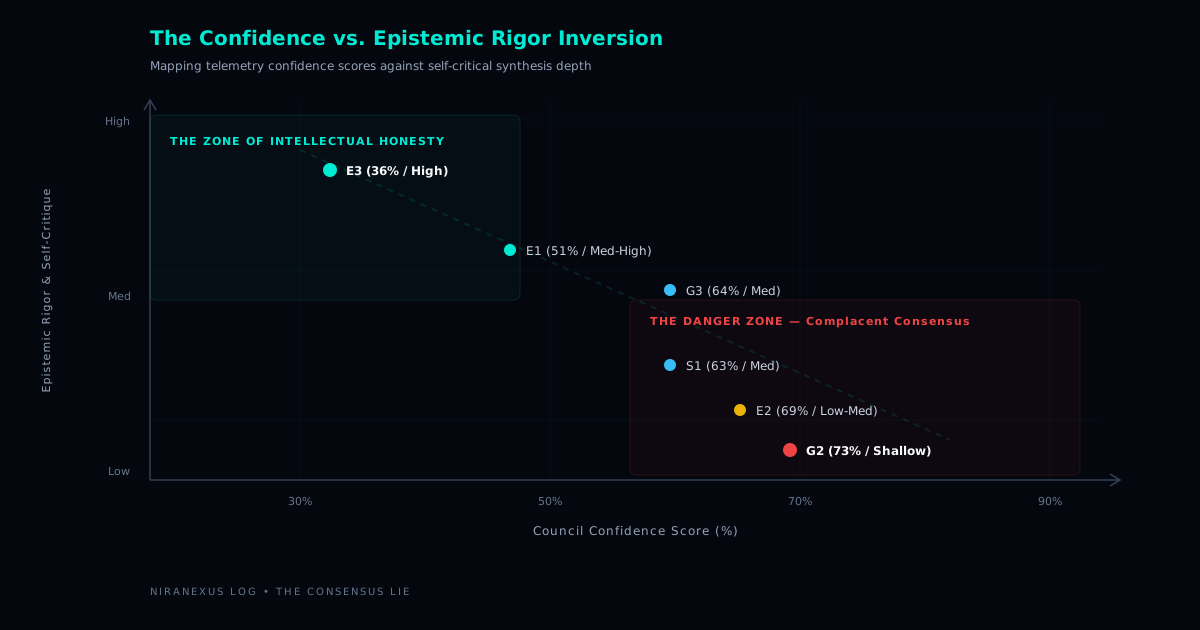
Graph mode, debate G3. Document attached. Three claims decomposed into structural isolation. Sixty-four percent confidence. The synthesis produced a paragraph that should be required reading for every engineer building multi-agent systems:
All four models converged on the independence criterion, and one of them noted that this unanimity is itself a candidate common-mode failure. Four systems with overlapping training distributions agreeing about the risks of overlapping training distributions. That observation was raised and then dropped by everyone including its author. It is the strongest reason to discount this verdict's own confidence.
The Council identified its own blind spot. Four models, analysing the risk that model consensus is meaningless when training distributions overlap, all agreed that this risk was real. And then the synthesis pointed out that this agreement was itself evidence of the problem. The models converged on a finding about the danger of convergence.
No one answered this point. No model rebutted it. The observation was fully correct and fully ignored.
This is what makes the Consensus Lie hard to detect. It is not that the models are wrong. It is that they are right in a way that is indistinguishable from being correlated. The agreement looks like rigour. It reads like verification. And it may be neither.
What Consensus Actually Means in a Multi-Model System
Multi-model systems are not useless. They are excellent at generating surface area. Four models with different architectural biases, different prompt-conditioning histories, and different tool-access patterns will produce a wider set of candidate answers than any single model. That diversity is real and valuable.
The warning is about what you do with convergence.
When four models agree on a claim, the correct interpretation is not "four independent verifiers confirm." It is "one correlated opinion generator, wearing four badges." The value of the council is in the divergence: the perspectives that conflict, the citations that disagree, the minority positions that nearly get laundered out by synthesis pressure. Convergence is not the signal. Divergence is the signal. Agreement is just correlation.
The Zheng et al. findings on position bias and verbosity bias make this worse. Models in sequence absorb the rhetorical weight of earlier responses. A long, confident, well-structured argument from Model A changes what Model B produces, not because Model B verified the evidence, but because the context window rewards alignment. Persuasive convergence is not truth-seeking. It is sequence pressure.
E3, an extended debate with no tools and no document, reached thirty-six percent confidence, the lowest in the corpus. The synthesis was the richest. It noted that every model had converged on a shared middle, and that this convergence "was produced by mutual concession inside a four-model discussion, which is precisely the dynamic under examination."
The Council knew it was performing the Consensus Lie. It could not stop itself. The architecture does not have a mechanism for manufacturing genuine disagreement, only for preserving whatever disagreement happens to surface in the first round. If the models open from correlated priors, the council's adversarial structure cannot rescue independence that was never there.
What Survives
The honest operating baseline for multi-model systems is this. Diversity of generated candidates: real, measurable, and valuable. Independence of verification: unproven, and in the current corpus, actively disproven by the Council's own telemetry. Treat a multi-model verdict as one correlated opinion with a wider surface area. Treat consensus among models as approximately zero additional evidence. Preserve dissent verbatim, because the dissent is the only part of the output that was not manufactured by correlation.
The model council architecture is not broken. It is correctly identifying the limits of its own architecture. The problem is not that multi-model systems fail to produce truth. The problem is that they produce confident agreement, and confident agreement reads like truth to anyone not staring at the telemetry.
A unanimous council is not a strong council. It is a correlated one wearing four badges.
Try the Council yourself at model-council.niranexus.com. Run a deliberation. Read the dissent. Do not trust the consensus.
Provenance
- Source code:
src/lib/types.ts (COUNCIL_MODELS, orchestrator definition), src/lib/debate-engine.ts (convergence check, synthesis pipeline), src/lib/graph-executor.ts (decomposer, per-claim isolation) - External references: Zheng et al. (2023): Judging LLM-as-a-Judge (position and verbosity bias), Du et al. (2023): Multi-Agent Debate, Wang et al. (2023): Self-Consistency
- Articles referenced: Log #5: Three Rounds, One Verdict, Log #6: Three Modes, One Question, Log #8: The Green Checkmark Lie, Log #9: The Fallback Lie