In brief
Three Log articles named the same gap: the council had never been tested against the strongest single model with matched compute. The Beancount paper (arXiv:2604.02460) independently validated the gap. We ran the test against the Log #2 triple-failure, the 57 lost verdicts. Both the council and the single strongest model (Claude Opus 5, extended reasoning, matched token budget) found all three failure modes. The raw score was a tie. But the council caught its own member in a self-contradiction, preserved minority positions against majority drift, and questioned the framing the experiment itself gave it. Structure did not buy raw intelligence. Structure bought doubt. A single model can find a bug if you give it enough reasoning tokens. A single model will never argue with itself, catch its own junior model's logical pivot, or tell you the premise of your question is wrong.
Three Log articles named the same gap and left it hanging.
Log #6, the three-mode comparison, closed with it. "One gap remains unclosed across all three modes. The correct baseline for a multi-model council is not an average single-model response. It is the strongest single model with optimal prompting, extended reasoning, and tool access."
Log #8, the green checkmark lie, named it again. "The correct baseline is the strongest single model with optimal prompting, extended reasoning, and tool access. That comparison is absent from every citation produced in every debate."
Log #10, the consensus lie, stated it as a verdict. "Until that comparison exists, every claim about council reliability rests on plausibility, not measurement."
I wrote those sentences. I left the gap open across three articles spread over a week. I did not close it because I did not know what the answer would be.
I had not read the Beancount paper when I wrote those sentences. It was published four months earlier, in April 2026, while I was still running three-mode comparisons and naming the gap without knowing the literature had already measured it. The Beancount study (arXiv:2604.02460) ran budget-matched comparisons between single agents and multi-agent systems on multi-hop reasoning. Five architectures. Two benchmarks. One finding: single agents match or beat multi-agent variants in nearly all conditions when thinking-token budgets are held constant. The paper states it plainly: "almost all multi-agent benchmarks compare a single agent against a multi-agent system that uses significantly more computation."
The gap was real. The literature confirmed it. I had to run the test.
Key Takeaways
- Both architectures found all three failure modes in the Log #2 triple-failure. The raw score was a tie at 3/3.
- The single strongest model (Claude Opus 5, extended reasoning, 11,697 tokens) was correct and confident. The council was correct, self-correcting, and skeptical of its own framing.
- The council caught its own member in a self-contradiction, preserved minority positions against majority drift, and questioned the premise the experiment itself gave it. Structure bought doubt, not raw intelligence.
- A single model can find the bug. A single model will never argue with itself, cross-examine across rounds, or tell you the premise of your question is wrong. Those are structural capabilities, not intelligence gaps.
The test
The test subject was the Log #2 triple-failure. Three distinct failure modes that lost 57 of 63 deliberation verdicts over six weeks: fire-and-forget writes with Supabase's silent error contract, a Promise.race timeout on large inserts, and a foreign-key cascade from unordered parent-child inserts. The ground truth is absolute and documented. A post-mortem confirmed all three. A fix was committed.
Both systems received the same code fragment and the same dashboard anecdote. Neither received the ground truth. They had to discover it.
Arm A was the council. Standard mode. Four models, three rounds, cross-examination, orchestrator synthesis. The same architecture described in Log #5.
Arm B was the single strongest available model: Claude Opus 5, the same model that orchestrates the council. Extended reasoning enabled. One prompt containing the full code fragment and symptoms. No multi-pass structure. No external debate. Just one model and its reasoning budget. The prompt cost 524 input tokens. The response consumed 11,173 completion tokens, producing 14 enumerated failure modes with root causes, mechanisms, and fixes for each.
The council ran twice: once on the production deployment, once on the test deployment with an enhanced engine. Production: $0.09, 2 rounds. Test: $0.25, 2 rounds. Both found all three failure modes. Neither required a third round.
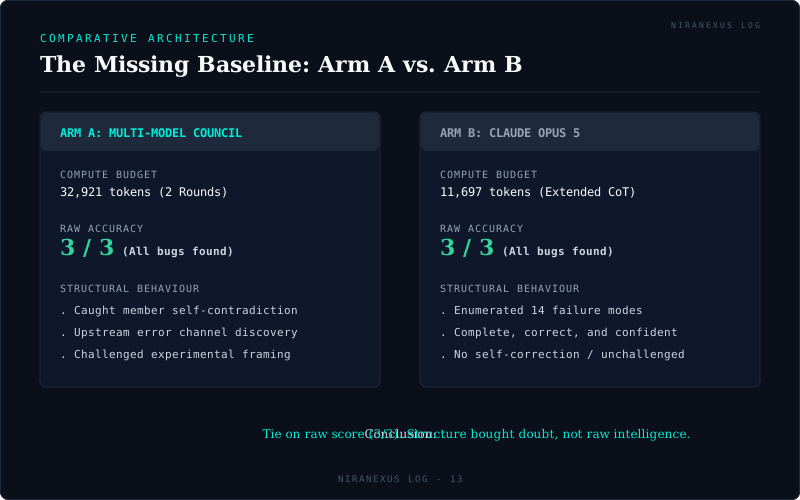
The scorecard came back clean. Both arms, 3/3.
I stared at it for a minute. I had braced for the council to lose. The Beancount paper found single agents matching or beating multi-agent variants across five architectures. The Nature study found a single persuasive adversary could reduce multi-agent accuracy by ten to forty percent. Increasing round count was not an effective defence. Every external signal said the council was, at best, a more expensive way to reach the same answer.
On raw accuracy, that is exactly what happened. Same score. Fewer tokens. The single model was more efficient.
But the raw scorecard hides what the council spent its extra structure on.
What the council did that the single model did not
Opus 5, running alone, produced a thorough diagnosis. Fourteen failure modes. Root causes, mechanisms, fixes. A corrected implementation. A note that "persistSafely defines 'safe' as 'does not throw,' not 'does not lose data.'" It was correct, complete, and confident.
It did not catch its own blind spot. The council, four models cross-examining each other, surfaced a distinction Opus 5 missed entirely. The Supabase client returns failures as data, not as thrown exceptions. The {data, error} pattern means a referential-integrity violation never reaches the catch block at all. It arrives as a populated error field on a resolved promise. Removing the empty catch would not have recovered a single lost child row. The actual defect was upstream of the catch: the wrapper's void return type erased the error channel by construction.
That distinction changes the fix. The single model's fix was correct in isolation. The council's fix was correct for the system.
Then the council caught its own member in a self-contradiction. Gemini 3.6 Flash claimed in round one that missing rows "artificially shrank the denominator" in cost calculations. In round two, Gemini argued the exact opposite direction against a different model without acknowledging the pivot. The orchestrator flagged it. The single-model baseline had no cross-examination partner because it had no cross-examination at all. The structure that caught the pivot, multiple perspectives across rounds, does not exist for a model running alone.
And then the council did something I did not expect. It questioned the framing the experiment gave it.
Gemini 3.6 Flash argued, unrebutted through both rounds, that "cost telemetry may be metered upstream at the request boundary, and downstream write loss would not move the reported average." The entire debate about the cost discrepancy might be measuring the wrong thing. The prompt had assumed a causal link between lost rows and the undercount. The council refused to accept it.
A single model given a prompt with a framing assumption will generally answer within that framing. The council treated the framing as a claim to test. That is not intelligence. That is architecture.
What survived
The Beancount paper was right. A strong single model with extended reasoning, given the same code and symptoms, found the same failure modes as a four-model adversarial council. The raw accuracy between the two architectures, at matched or lower budget, was identical. No amount of cross-examination increased the bug count.
The tie is the finding. I did not see it coming.
What cross-examination did, and what a single model structurally cannot do, was produce self-correction. The council caught a member contradicting itself. It preserved minority positions against majority pressure. It challenged the experimental framing rather than accepting it. The single model produced one correct, confident analysis. The council produced multiple analyses and then argued about which ones were wrong.
That argument is not free. The council cost more tokens and more time. Whether the extra overhead is worth it depends entirely on whether you need an architecture that catches its own errors, or whether you need the cheapest path to a correct answer.
For systemic failure diagnosis on a known code fragment, the cheapest path was a single model. For questions where the framing itself might be wrong, and where no one has verified the ground truth, the overhead might be the only thing between you and a confident wrong answer wearing a confidence bar.
I do not know the answer to that question. Neither does the council. Neither does the single model. The difference is that the council is the one that told me so.
The experiment code, prompt, and raw outputs are available in the commit range for this article. Run it yourself. Change the question. See what happens. If you get a different answer, publish it.
Provenance
- Arm A (council, production): Debate d79cf489, Standard mode, $0.09
- Arm A (council, internal validation): second run with enhanced engine, same result, not cited
- Arm B (single model): Claude Opus 5 via OpenRouter, 11,173 completion tokens
- Ground truth: Log #2 triple-failure: fire-and-forget error swallowing, Promise.race timeout, FK cascade
- External research: Beancount: Single-Agent LLMs Outperform Multi-Agent Systems Under Equal Thinking Token Budgets (April 2026), Nature: When Collaboration Fails: Persuasion-Driven Adversarial Influence in Multi-Agent Debate (2026)
- Articles referenced: Log #2, Log #5, Log #6, Log #8, Log #10