The governance dashboard showed a number that made no sense. Average deliberation compute. Impossible. Dividing six valid rows across the full corpus produced a ratio that could not exist. The impossibility was the signal.
Fifty-seven verdicts in the database had NULL in their tracking column. The code had been writing to that column for two months. No migration ever created it. It was ghost-writing into the void. The full postmortem is in Log #2.
The fix was three lines. Error destructuring on the database write. A longer timeout. Ordered inserts so referential integrity constraints do not silently reject every row. Three lines closed the crash window.
And then the gate. The pre-code pipeline now catches the NULL pattern before a deployment leaves the machine. The same number that caught the data loss is now the signal that drives the gate.
This is the pattern. A fire. A diagnosis. A fix. A gate. The gate ensures that specific fire can never recur. Not "should not." Cannot. The gate refuses.
Not every gate was earned by a fire. Some are preventative. JSX inline comments, HTML button nesting, async generators in the wrong runtime. These catch known failure patterns before they compound. They were not born from a specific incident. They were born from pattern recognition.
But the gates that were earned stay earned forever.
Three Days Watching Compute Burn
The circuit breaker was not planned. I did not sit down and design it. I watched a failure for three days before I understood what I was watching.
A debate would start. Four models would receive prompts. Three would respond. One would return empty. Not an error. Just nothing. The fallback chain would fire. Three alternative models, two attempts each. Compute consumed on every attempt. The debate would complete with a partial verdict. The user would see three model cards and one blank space. No error logged. No explanation. Just a missing card.
I spent three days watching this happen before I realised the engine did not need better monitoring. It needed a refusal mechanism. The full architecture is in Log #4.
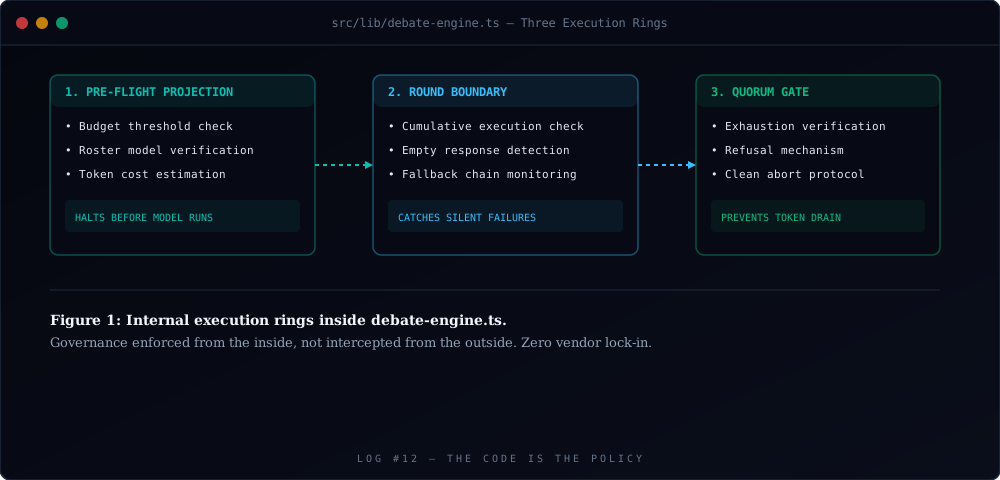
Three yield points now enforce every debate. The pre-flight projection checks the model roster against the threshold before any model runs. The round boundary evaluates cumulative execution against the projection after each round. The quorum gate halts the debate if all models fail and all fallback chains are exhausted.
The circuit breaker is not a configuration file. It is not a feature flag. It is three functions. Each function has one job. Check whether execution is healthy enough to continue. If the answer is no, halt. Not after the fact. Before.
The following diagram shows the three yield points as they sit inside the debate engine, each gating the next stage of execution.
According to Microsoft's Agent Hypervisor specification, four execution rings with explicit resource constraints per ring provide the governance boundary. Ring 3, the sandbox, limits agents to 10 calls per minute. According to Gartner's 2026 observability forecast, only 15 percent of production GenAI deployments have instrumentation today, projected to reach 50 percent by 2028. The Zero-Trust for Agents paper, published through NIST AI RMF, states that tripwires are automated checks detecting when agent behaviour deviates from policy, with a target service level objective of 95 percent of dangerous actions halted within 5 seconds of detection.
The industry is building platforms. I built three functions. The difference is not quality. It is proximity. A hypervisor governs from the outside. It intercepts calls, enforces rings, logs actions. A circuit breaker governs from the inside. It is part of the engine. Same privilege level. Same outcome. Zero vendor lock-in.
The pattern is not unique to this project. Waxell documented a developer who woke up to an overnight API bill after their agent entered a retry loop at 11pm and never stopped. The developer community has figured this out empirically. A kill switch is what you reach for after something has gone wrong. A circuit breaker stops it before the bill arrives. Phantom Byte published the same conclusion from the solo developer side: one company raised an eight-figure funding round for agent interaction infrastructure. "Here is the brutal truth: this is infrastructure you can build yourself in two hundred lines. Token budget circuit breakers solve this." The market is validating the problem with venture capital. The builders are solving it with functions.
Six Dead Models. Zero Alerts.
Six of eleven fallback models were dead. The engine had no idea. Nobody knew. The only way to discover it was a manual audit against the live model registry. Nobody ran that audit. The models sat in the roster, unreachable, for an unknown number of weeks.
I found it by accident. The same way I found the dashboard number. The same way I found the three-day compute burn. Every meaningful discovery in this project has been an accident. That is not a coincidence. It is a design gap. The system should have told me. It did not. So I built something that would.
A Python script. A daily check. Every morning, the script reads every model ID from the roster, queries the live endpoint directory, and diffs the two sets. Dead models are flagged and reported. The audit does not fix anything. It surfaces the drift before a user triggers a debate that would fail. The full roster architecture is in Log #7.
The roster is not a configuration file. It is a maintenance contract. The daily audit is the enforcement mechanism. The check does not trust memory. The check does not trust documentation. The check hits the live API and reports the truth.
Same pattern. Fire. Diagnosis. Fix. Gate. Three fires. Three gates. The pattern is the architecture.
The Twenty-One Checks
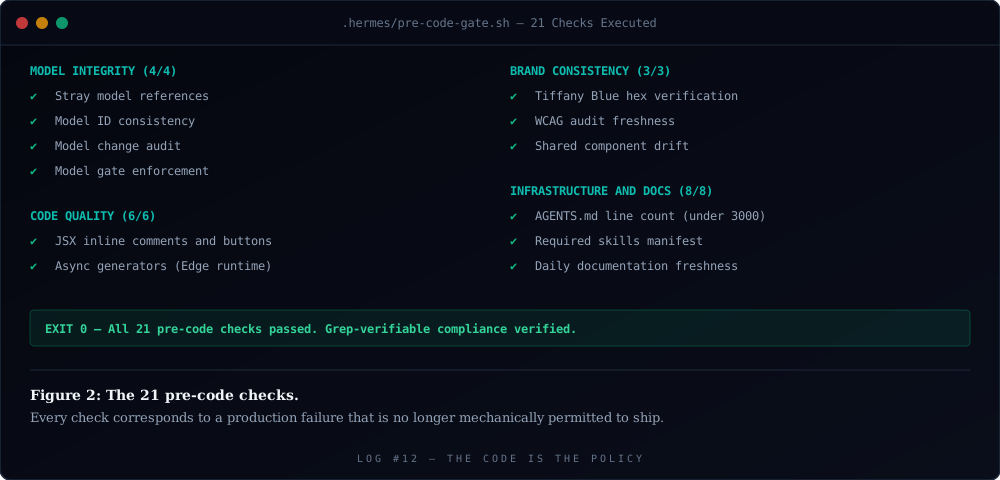
The three fires above produced three specific gates. They are not the only gates. The pipeline now runs twenty-one checks across five categories.
Model integrity. Stray model references. Model ID consistency. Model change audit. Model gate enforcement. Every model ID in the codebase is verified against the live roster. The gate that caught the dead fallback models is one of four.
Code quality. JSX inline comments. HTML button nesting. Async generators for the wrong runtime. Dead duplicate files. Eager environment assertions. Import and dependency consistency. The gate that caught the rendering pipeline order bug from Log #3 is here. Every check was added because a known failure class needed mechanical prevention.
Brand consistency. Brand colour audit. WCAG audit freshness. Shared component version drift. The three-job palette rule is enforced mechanically. The background surface, the card surface, the border accent. The gate does not ask whether the designer approves. It greps the hex values and blocks the build if they drift.
Infrastructure health. Operational knowledge base line count. Required skills manifest. Completion contract. Build cache freshness. The gate that monitors the project's operational memory is itself a gate. The knowledge base exceeding the readability threshold triggers an archive recommendation. The knowledge base cannot become unreadable because the gate refuses to let it.
Documentation freshness. Design spec for today. Impact audit for today. Production-readiness audit. Pre-completion pipeline. Calendar-date checks. Every session, every feature, every deployment has a mechanical paper trail. The gate does not ask whether you wrote the spec. It checks whether the file exists.
The pipeline is not a specification document. It is a bash script. It runs on every commit. The output is machine-readable. The exit code is the evidence. I do not self-report compliance. The gate reports it for me. The full Model Council specification documents the engine architecture that the gates protect.
The table below shows the full breakdown of all twenty-one checks across the five enforcement categories.
The number changes. Every production incident that could have been caught mechanically adds a new check. The gates are not a fixed specification. They are encoded operational memory. My operational memory. The machine remembers what I forgot.
The enterprise AI governance market is consolidating around platforms. Agent hypervisors. Observability suites. Compliance dashboards. The pitch is identical. Buy our platform. Configure our policies. Your agents will be governed.
The Model Council does not use any of them. The governance layer is not a platform. It is not a subscription. It is not a configuration file. It is a bash script and three functions. The script runs before every commit. The functions run inside every debate. The daily audit runs every morning. Four layers of mechanical enforcement. Zero vendor lock-in. This is adversarial deliberation architecture applied to the development pipeline: the same cross-examination principle that governs model outputs also governs the code that ships them.
The philosophical difference is not cost. It is proximity. A platform governs from the outside. It intercepts calls, enforces policies, logs actions. The circuit breaker governs from the inside. It is part of the engine. When the quorum gate halts a debate, it is not an external policy engine making a decision. It is the engine refusing to proceed because the execution is unhealthy.
A governance document says "we will verify tracking columns are populated." The gate greps the source and blocks the build if the write path is missing. The document is a promise. The gate is a refusal. Documents are read once and forgotten. Gates run on every commit. The difference is enforcement.
CTE Research published a piece in May 2026 called "Hard Constraints, Not Policies" that maps this distinction with surgical precision. A policy is a description of intended behaviour. It exists at the documentation layer. A hard constraint is enforced at the code layer before any action is taken. When a policy violation occurs, the investigation is about who failed to enforce it. When a hard constraint fires, there is no investigation. The action did not happen. Pre-commit hooks run before code enters the repository. A constraint enforced only at code review is a policy. A constraint enforced at commit time, by a hook that rejects the commit on violation, is a hard constraint.
That is exactly what the pre-code gate pipeline does. It does not review. It does not recommend. It refuses. The commit does not enter the repository if the gate fails. The deployment does not leave the machine if the constraint is violated. The code is the policy because the policy has been compiled into code that cannot be overridden without human intervention.
An arXiv paper from May 2026, "Mechanical Enforcement for LLM Governance," tested this experimentally. Under text-only governance, 27 percent of model deferrals were informationally vacuous. They looked compliant but carried zero decision-relevant information. Mechanical enforcement reduced that rate by 73 percent. The finding: "documentation-based governance is necessary but not sufficient. It satisfies the letter of compliance requirements while failing their intent." The researchers were studying financial decision systems. The finding generalises. To everything.
Not every gate was earned by a fire. The ones that were stay earned forever. The ghost-writing column cost 57 verdicts. The empty response loop burned compute for three days. The dead fallback models sat undiscovered for weeks. Each fire produced a gate. The gate ensures that specific fire can never recur. Not "should not." Cannot. The gate refuses.
The four layers operate at different cadences. The pre-code gates run on every commit, catching structural drift before a deployment leaves the machine. The circuit breaker runs inside every debate, halting execution when models return empty. The model audit runs every day, verifying the roster against the live registry. The governance dashboard runs continuously, surfacing anomalies in the telemetry that no single gate could catch. Commit-time. Debate-time. Daily. Continuous. Four enforcement rhythms. One invariant.
The Verification Illusions trilogy proved the machine manufactures authority. The gates are the mechanical answer. The badge, the consensus, and the confidence bar are generated. The gates are refusal. The machine produces the illusion. The gate refuses to let it ship.
The gates prevent the machine from lying. The next question is what happens when the machine, governed honestly, hits a question it cannot answer. That is a different article.
Every gate in the Model Council pipeline that was earned by a fire stays earned forever. Read the full governance architecture at niranexus.com/model-council. The pre-code gate script is in the repository. The circuit breaker is in the engine. The model audit runs daily. No platform. No subscription. Just code that refuses to let the same fire burn twice.
Provenance
- The Verification Illusions trilogy: Log #8: The Green Checkmark Lie, Log #9: The Fallback Lie, Log #10: The Consensus Lie, Log #11: The Confidence Lie
- Source code:
.hermes/pre-code-gate.sh (21 mechanical checks), src/lib/debate-engine.ts (circuit breaker, quorum detection), src/lib/types.ts (fallback chains, roster), model-audit.py (daily model registry verification) - Articles referenced: Log #2: How Fire-and-Forget Writes Lost 57 Verdicts, Log #3: How a Workaround Became the Bug, Log #4: Execution Integrity, Log #7: The Roster Problem
- External references: CTE Research: Hard Constraints, Not Policies (Aug 2026), arXiv: Mechanical Enforcement for LLM Governance (May 2026), Microsoft Agent Hypervisor, Gartner 2026: GenAI Observability Forecast, Zero-Trust for Agents: NIST AI RMF, Waxell: AI Agent Circuit Breakers, Phantom Byte: Build Your Own Damn Infrastructure
- Engine specification: Model Council